Flat Panel QA: A Complete Toolkit for Digital X-ray Detector Characterisation
Introduction
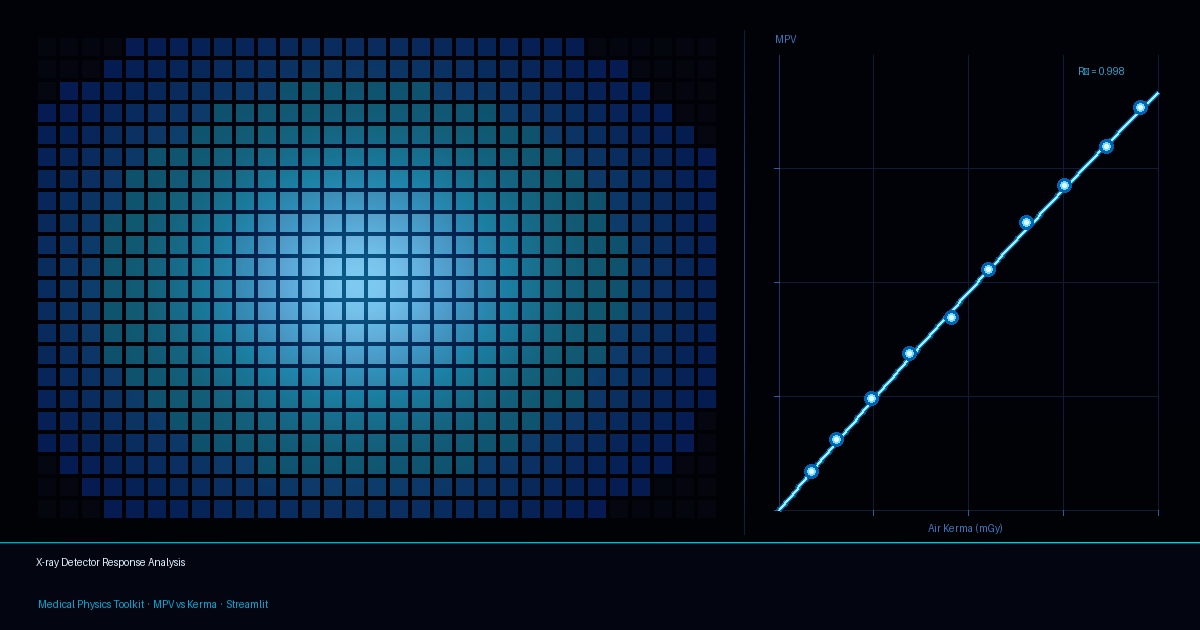
Characterising a flat panel X-ray detector properly means more than running a quick uniformity check. A thorough QA programme requires quantifying spatial resolution, frequency-dependent noise, dose efficiency, and contrast detectability — following the same international standard across every measurement so results are comparable and reproducible.
The X-ray Imaging Analysis Toolkit is a Streamlit web application that implements the complete flat panel QA pipeline defined in IEC 62220-1-1:2015. It operates on raw, unprocessed detector images (“FOR PROCESSING”) to measure intrinsic detector performance, independent of any manufacturer post-processing.
The Analysis Pipeline
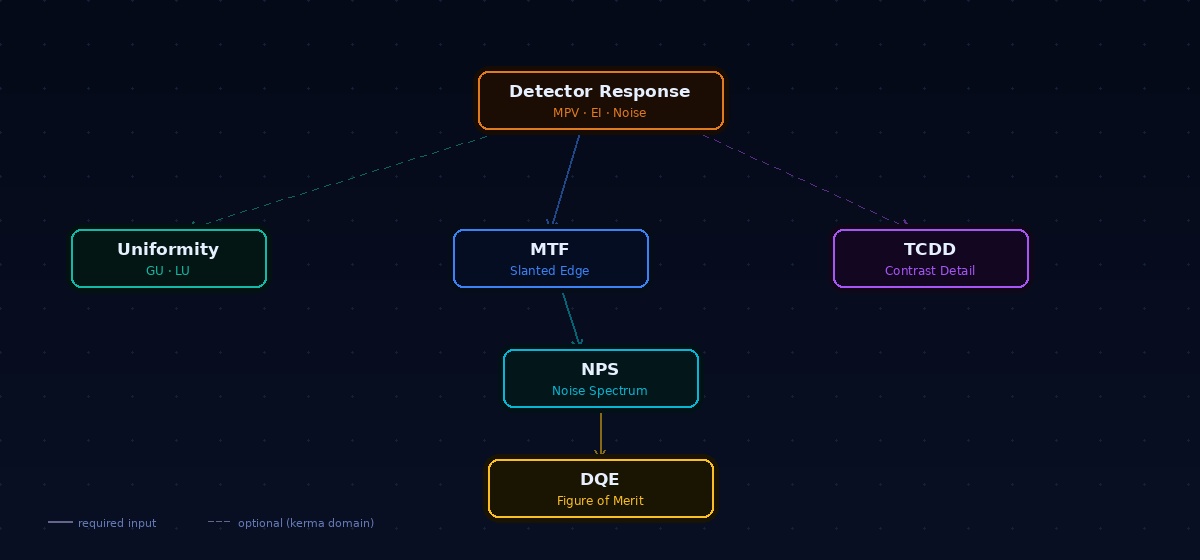
The six modules form a logical dependency chain where earlier analyses feed directly into later ones. Solid arrows indicate required inputs; dashed arrows indicate the optional kerma-domain mode enabled when the detector response fit is available.
Detector Response Characterisation
Everything else depends on knowing how the detector converts incident radiation into digital output. This module takes a series of flat-field exposures acquired at different dose levels and fits the MPV vs Air Kerma relationship:
| Image type | Fit model |
|---|---|
| RAW (linear encoding) | |
| STD (log-encoded) |
The fit method can be auto-detected from the DICOM tag (0028,1040) PixelIntensityRelationship. Results are characterised by and maximum deviation. The fitted prediction function — and its inverse — are cached in session state for use by every downstream module.
The same set of exposures also yields two additional analyses:
EI vs Air Kerma — A linear fit of the IEC 62494-1 Exposition Index against kerma (), enabling cross-manufacturer exposure level comparisons.
Noise Decomposition — The total variance across the measured kerma range is decomposed into three physical components:
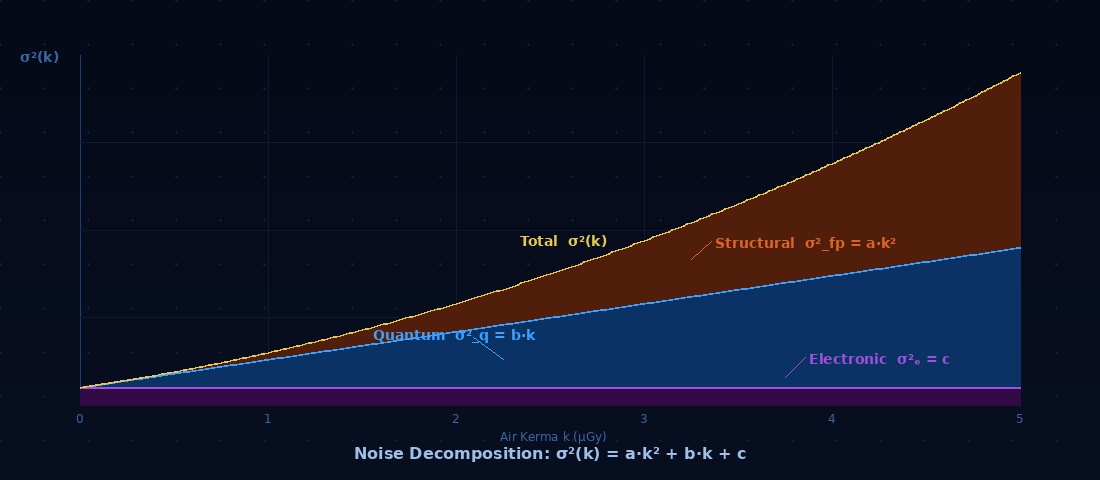
The structural component is measured directly from repeated exposures at a single reference kerma level using the division method (Monnin et al., Phys. Med. Biol. 59, 2014). Dividing each frame by the pixel-wise mean across all frames normalises out the multiplicative fixed-pattern noise, isolating the stochastic (quantum + electronic) component. Electronic and quantum components are then separated by weighted linear extrapolation of the stochastic variance to .
Spatial Uniformity
A 30 mm × 30 mm moving ROI slides across the central 80% of a flat-field image with a 15 mm step. For each position, MPV, SD, and SNR are computed. Two levels of uniformity are reported:
Global Uniformity (GU) — Maximum deviation of any ROI from the overall mean:
Local Uniformity (LU) — The same metric computed relative to each ROI’s 8 immediate neighbours. This catches localised defects that global metrics can miss.
When the detector response fit is available in session state, the analysis can run entirely in kerma domain, providing a physics-based uniformity assessment expressed in dose units rather than arbitrary pixel values.
Modulation Transfer Function (MTF)
Spatial resolution is measured via the slanted edge method specified in IEC 62220-1-1:2015. The user uploads one or two RAW images of a lead or tungsten edge phantom tilted slightly off-axis.
Algorithm:
- Hough Transform detects the edge angle and orientation.
- Pixel values are projected perpendicular to the edge to build the Edge Spread Function (ESF), oversampled by the slant angle.
- The Line Spread Function (LSF) is computed as the numerical derivative of the ESF.
- The MTF is the magnitude of the Fourier Transform of the LSF: .
IEC 62220-1-1 requires edge angles of 3°–5° (horizontal) or 85°–87° (vertical). The UI reports angle compliance and flags any deviation from this range.
When two orthogonal edge images are provided, the module computes the geometric mean MTF:
This isotropic MTF is required as input to the DQE calculation.
Key metrics: (practical resolution limit) and (high-frequency cutoff), both in lp/mm.
Noise Power Spectrum (NPS)
The NPS quantifies frequency-dependent noise following IEC 62220-1-1:2015. One or more uniform flat-field images are accepted; multiple images improve statistical reliability (IEC recommends total analysed pixels).
Algorithm:
- A large central ROI (default 1024 px, adjustable 25–250 mm) is extracted from each image and subdivided into small ROIs (default 128 px).
- Each small ROI undergoes a 2D FFT; power spectra are averaged across all ROIs and all images.
- The result is normalised to yield the NNPS:
Outputs: radial-average NNPS () for display, plus directional X and Y profiles for detecting anisotropic noise such as scan-line artefacts. The raw 1D NPS in mm² is cached for DQE computation. A warning is issued if the analysed pixel count falls below the IEC threshold.
Detective Quantum Efficiency (DQE)
DQE is the single figure of merit for a digital X-ray detector — it quantifies what fraction of the dose reaching the detector is actually converted into useful signal information. The IEC 62220-1-1:2015 working formula is:
where is the photon fluence per unit kerma for the RQA5 beam quality specified by the standard, and is the air kerma in . NNPS here is the raw 1D NPS in mm².
Both MTF (geometric mean from two orthogonal edges) and NPS must be completed in the same session. The module interpolates them onto a common frequency grid (300 points across the intersection of their frequency ranges) and reports:
| Metric | Meaning |
|---|---|
| Low-frequency dose efficiency | |
| at | Frequency at which half the input is preserved |
| at | High-frequency cutoff |
Interpretation:
| Assessment | |
|---|---|
| 0.6–0.8 | Excellent (modern CsI/a-Si or Se-based panels) |
| 0.4–0.6 | Good (well-maintained system) |
| 0.2–0.4 | Fair (ageing or suboptimal configuration) |
| < 0.2 | Poor — investigation warranted |
Threshold Contrast Detail Detectability (TCDD)
TCDD estimates the minimum detectable contrast as a function of detail size, using the statistical method described by Paruccini et al. (2021). It operates on a flat-field image independently of MTF and NPS, but like Uniformity it benefits from the detector response fit when available — optionally converting pixel values to kerma domain before computing contrast thresholds.
From a uniform flat-field image, sub-ROIs of varying size are sampled across the central px region. For each detail size, the threshold contrast at 95% confidence is:
where is the standard deviation of sub-ROI means at that size. Results are normalised to the mean signal and expressed as a percentage.
The contrast-detail relationship is fitted to , and key values at and are reported for cross-system comparison.
IEC 62220-1-1:2015 Compliance
| IEC Requirement | Module | Implementation |
|---|---|---|
| Slanted edge MTF | MTF | Hough-based edge detection, ESF → LSF → FFT |
| Edge angle 3°–5° or 85°–87° | MTF | Angle detection with compliance flag |
| Geometric mean of orthogonal MTFs | MTF | Automatic when 2 images provided |
| NPS from pixels | NPS | Multi-image support with pixel count warning |
| NNPS normalisation | NPS | with unit conversion |
| DQE | RQA5 , raw NPS in mm² | |
| Detector response linearity | Detector Response | MPV vs kerma (linear or log), auto-detected from DICOM |
Getting Started
All modules are available in the web application. Upload your DICOM or RAW flat-field and edge phantom images and run the modules in pipeline order — each result feeds the next.
Last modified: 19 Sep 2026